Most RV parks don’t have a traffic problem.
They have a conversion problem.
Every month, potential guests visit your website, browse your amenities, compare site options, check rates, and explore nearby attractions. Yet many leave without making a reservation.
That’s not just a missed opportunity. It’s lost revenue.
Whether visitors arrive through Google Search, social media, campground directories, or paid advertising, every unbooked visitor represents marketing dollars that failed to produce a return.
The good news is that increasing direct bookings doesn’t always require more traffic. In many cases, improving how your website converts visitors into guests delivers faster results than investing in additional marketing.
This is where Conversion Rate Optimization (CRO) becomes one of the most valuable growth strategies for RV parks.
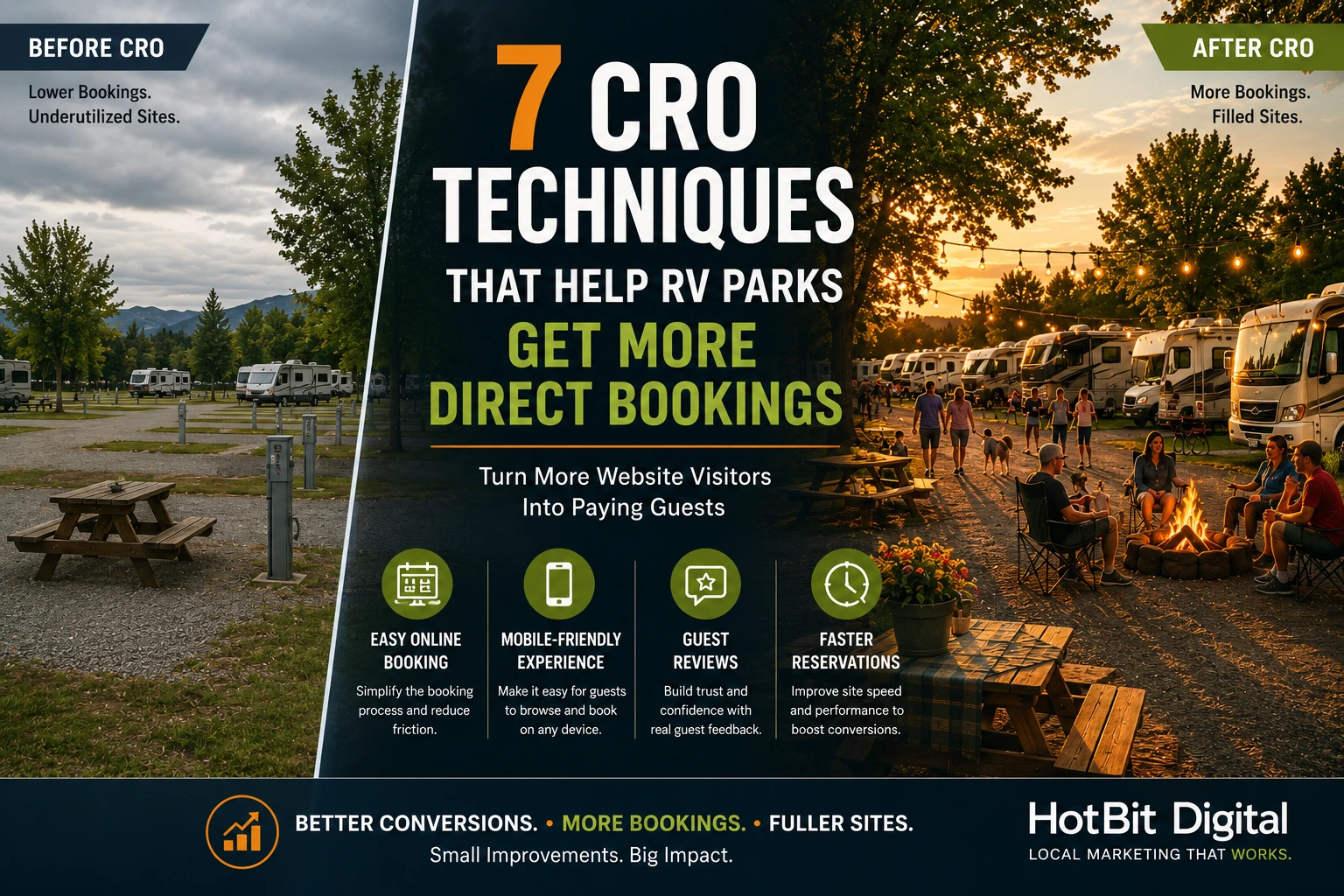
If you’re wondering how to convert more RV park website visitors into guests, these seven CRO techniques can help you capture more reservations from the traffic you’re already getting.
Why CRO Matters More Than More Traffic
When reservations slow down, many RV park operators immediately look for ways to increase website traffic.
More traffic can certainly help. But traffic alone doesn’t guarantee bookings.
Look at this example:
Monthly Website Visitors | Conversion Rate | Monthly Bookings |
5,000 | 2% | 100 |
5,000 | 3% | 150 |
A one-percent increase in conversion rate produces 50 additional bookings without increasing your advertising budget, SEO investment, or directory spend.
That’s why CRO often delivers one of the highest returns on investment in RV park marketing.
Instead of focusing exclusively on attracting more visitors, successful parks focus on making it easier for existing visitors to become guests.
1. Reduce Friction in Your Online Reservation Process
Every extra click in your reservation process costs bookings.
RV travelers are comparison shopping. If they encounter hidden pricing, confusing navigation, account creation requirements, or a complicated reservation flow, they rarely stop to troubleshoot. They simply move on to the next park.
How to Reduce Friction in Online Reservations
Ask yourself:
- How many steps does it take to book a site?
- Is availability visible immediately?
- Can guests see pricing upfront?
- Are site types easy to understand?
- Can reservations be completed without creating an account?
The best-performing RV park websites make booking feel effortless.
Guests should be able to:
- Select dates
- View available sites
- Choose their preferred option
- Complete payment
The shorter and simpler the journey, the higher the conversion rate.
2. Optimize Your Booking Page to Close More Reservations
Many RV park websites treat the booking page as an afterthought.
That’s a mistake.
Your booking page is where revenue is generated. Every element on the page should help visitors feel confident enough to complete a reservation.
How to Optimize an RV Park Booking Page
A high-converting booking page should include:
- Real-time availability
- Clear pricing
- Site photos
- Amenity details
- Cancellation policies
- Frequently asked questions
- Guest reviews
- Mobile-friendly functionality
One of the biggest booking killers is uncertainty.
If visitors can’t quickly answer questions about site size, hookups, pet policies, amenities, or cancellation terms, many will leave before booking.
The parks generating the most direct reservations remove doubt before it becomes a reason to leave.
3. Mobile Visitors Shouldn't Have to Work to Book
Mobile optimization for RV park websites is no longer optional.
Many travelers are researching campgrounds while actively traveling. They’re comparing parks from their phones, checking availability between destinations, and making booking decisions on the go.
If your mobile experience is frustrating, you’re losing reservations.
Common Mobile Conversion Problems
- Small buttons
- Slow-loading pages
- Difficult forms
- Broken layouts
- Hard-to-read text
- Complicated navigation
Visitors should be able to complete a reservation from a smartphone in just a few minutes.
The easier the mobile experience, the more direct bookings you’ll generate.
4. Improve Website Speed Before Spending More on Marketing
Many RV parks invest heavily in advertising while overlooking a major conversion issue: website speed.
A slow website quietly kills bookings.
- Travelers expect fast-loading websites. With website speed optimization, we help your RV park site load quickly so visitors can view availability and book without frustration.
Website Speed Impact on Bookings
Slow websites often lead to:
- Higher bounce rates
- Lower engagement
- Reduced trust
- More abandoned reservations
Speed improvements can include:
- Compressing large images
- Optimizing hosting
- Removing unnecessary plugins
- Reducing bulky scripts
- Improving caching
Before increasing your ad spend, make sure your website can convert the traffic you’re already paying for.
5. Build Trust Before Asking for the Booking
Travelers are cautious when booking accommodations online.
Before they hand over their payment information, they want reassurance that your park is worth choosing.
This is where trust signals become critical.
Website Trust Signals for Travel Bookings
Strong trust elements include:
- Google reviews
- Recent guest testimonials
- Professional photography
- Secure payment indicators
- Clear contact information
- Park policies
- Awards or certifications
One overlooked factor is authenticity.
Generic stock photos don’t build confidence.
Real photos of your sites, amenities, facilities, and guests create a stronger connection and help visitors visualize their stay.
Trust reduces hesitation, and less hesitation leads to more bookings.
6. Use Calls to Action That Actually Drive Reservations
Many RV park websites make visitors work too hard to find the next step.
If your booking button is difficult to find or uses weak language, you’re creating unnecessary friction.
Best Call to Action for RV Park Websites
High-performing calls to action include:
- Check Availability
- Reserve Your Site Today
- Book Your Stay
- View Available Sites
- Secure Your Spot
These phrases are direct and action-oriented.
Compare them to weaker alternatives such as:
- Learn More
- Continue
- Submit
The best calls to action remove ambiguity and clearly communicate what happens next.
Your booking button should be visible on:
- The homepage
- Site pages
- Amenity pages
- Attraction guides
- Blog content
Never assume visitors will navigate back to find your reservation page.
7. Use Reviews to Turn Visitors Into Guests
Reviews do more than build credibility.
They help close bookings.
When travelers compare multiple RV parks, guest experiences often become the deciding factor.
Use Reviews Throughout Your Website
Don’t hide reviews on a dedicated testimonials page.
Feature them on:
- Your homepage
- Booking pages
- Site type pages
- Local attraction content
- Seasonal camping pages
Look for reviews that mention:
- Clean facilities
- Friendly staff
- Convenient location
- Family experiences
- Quiet atmosphere
- Easy check-in process
The more specific the review, the more persuasive it becomes.
Future guests want proof that they’ll have a positive experience. Reviews provide that reassurance.
The Cost of Ignoring CRO
Many RV parks focus entirely on generating more traffic.
Meanwhile, conversion issues continue to drain revenue.
A website that receives thousands of visitors but struggles to convert them into guests creates a costly bottleneck.
Even modest improvements to your booking experience can significantly increase reservations over the course of a season.
The parks seeing the strongest results are not always the ones with the largest marketing budgets.
They’re often the ones with websites designed to convert.
More Direct Bookings Start With a Better Website Experience
Every RV park owner wants more direct bookings.
But chasing more traffic isn’t always the answer.
If visitors are landing on your website but not completing a reservation, there’s usually something getting in the way. Maybe the booking process feels complicated. Maybe the site is slow on mobile. Maybe guests aren’t finding the information they need to feel confident booking.
The RV parks that consistently generate more direct reservations aren’t always the ones attracting the most visitors. They’re the ones making it easiest for travelers to say “yes.”
Even small improvements to your booking experience can have a meaningful impact on revenue over the course of a season. A clearer booking page, faster load times, stronger guest reviews, or a better mobile experience can all help turn more website visitors into paying guests.
Are You Losing Bookings Without Realizing It?
Most RV park owners know how many bookings they’re getting.
Far fewer know how many they’re losing.
If your website gets steady traffic but reservations aren’t where you’d like them to be, it may be worth taking a closer look at the experience you’re giving potential guests. Sometimes the biggest growth opportunities aren’t found in more advertising—they’re hiding in the gaps between a visitor arriving on your website and completing a booking.
That’s where we help.
At Hotbit Digital, we work with RV parks to uncover the small issues that quietly cost bookings every day. From improving booking pages and mobile experiences to identifying conversion bottlenecks across your website, we focus on helping parks get more value from the traffic they already have.
Because at the end of the day, a successful RV park website isn’t measured by clicks or pageviews. It’s measured by filled sites, longer stays, and more direct reservations.
If you’re curious about how many bookings your website might be leaving on the table, a CRO audit is a great place to start.
Frequently Asked Questions RV Park Owners
Why is mobile optimization important for RV park websites?
Many travelers search for and book campgrounds from their phones. A poor mobile experience can lead directly to abandoned reservations and lost revenue.
How does website speed affect bookings?
Slow websites increase bounce rates and create frustration. Faster websites generally convert more visitors into guests because they provide a smoother user experience.
What is the best call to action for an RV park website?
Calls to action such as “Check Availability,” “Reserve Your Site Today,” and “Book Your Stay” typically perform best because they clearly communicate the next step.
What trust signals help increase travel bookings?
Guest reviews, testimonials, secure payment indicators, professional photography, clear policies, and visible contact information all help build trust and improve conversion rates.