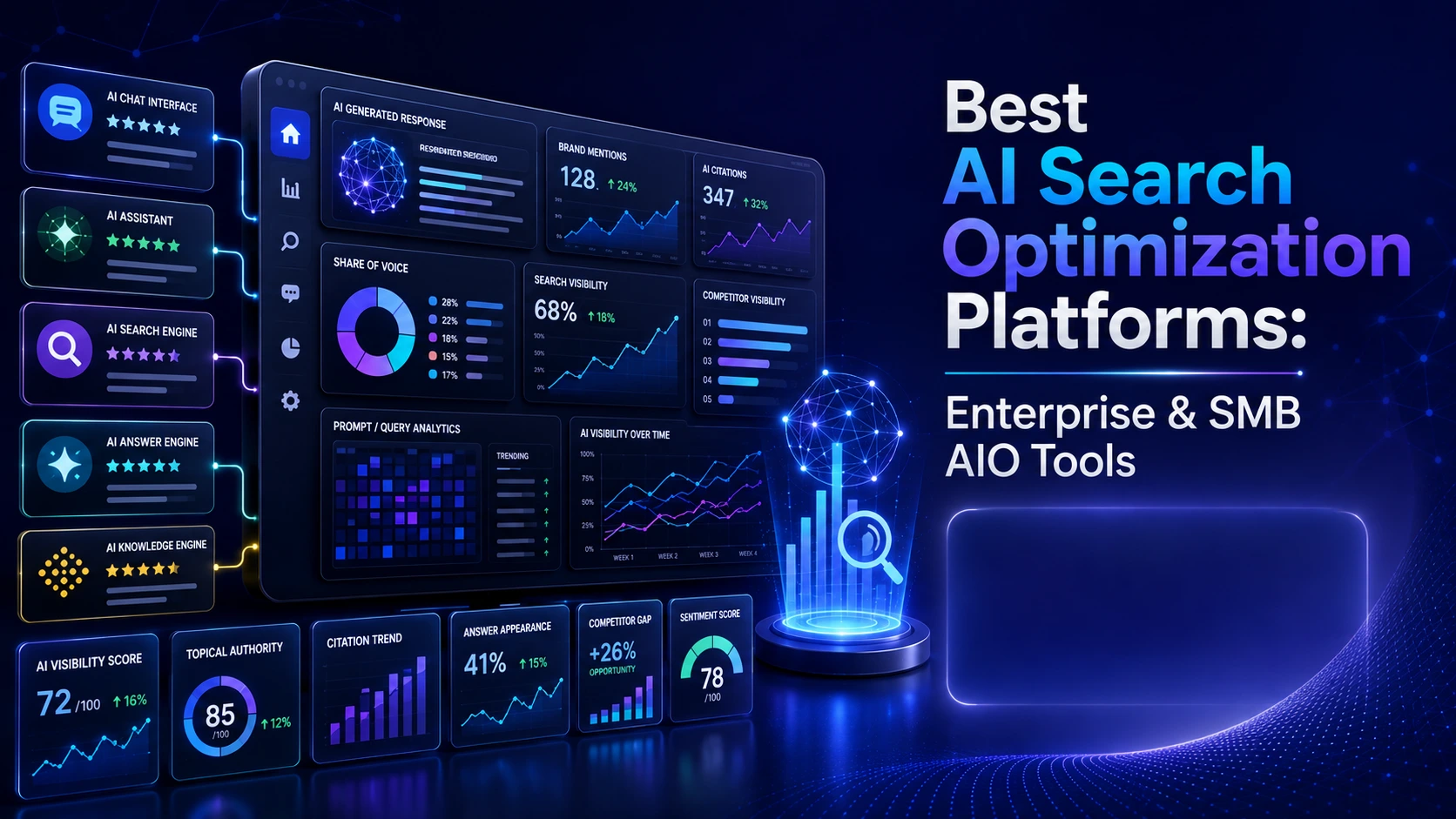
Search is changing fast.
People are still using Google to find businesses, products, services, and information. But they are also using ChatGPT, Gemini, Perplexity, Google AI Overviews, and Google AI Mode to get answers, compare options, and research brands.
This has created a new challenge for businesses.
Ranking on Google is still important. But what happens when a customer asks an AI platform for the best company, product, service, or solution in your industry?
Does your brand appear?
Does the AI mention your competitors instead?
Which websites does it use as sources?
This is where AI search optimization platforms are becoming important.
These tools help businesses monitor their visibility across AI search platforms and understand how their brands are being represented.
AI search optimization is also being described as AI visibility optimization, Answer Engine Optimization (AEO), Generative Engine Optimization (GEO), and AIO.
The terminology may vary, but the goal is similar: improve your chances of being discovered and mentioned when customers use AI-powered search.
In this guide, we look at some of the best AI search optimization platforms in 2026, including tools for small businesses, agencies, and large enterprises.
What Is an AI Search Optimization Platform?
Traditional SEO focuses heavily on rankings.
You research keywords, optimize pages, build authority, improve technical SEO, and monitor your position in search results.
AI search works differently.
An AI platform may answer a customer’s question directly instead of showing them a list of ten websites.
For example, a person could ask an AI assistant to recommend project management software for a growing company. The response may mention several brands and cite websites that support the answer.
An AI search optimization platform helps you understand what is happening inside these AI-generated answers.
These platforms can track things such as:
- Brand mentions
- AI citations
- Competitor visibility
- AI Share of Voice
- Tracked prompts
- Cited pages
- Sources influencing AI answers
- Changes in visibility over time
Ahrefs, for example, measures AI visibility using mentions, citations, impressions, and AI Share of Voice.
Semrush also provides AI visibility reporting that includes mentions, cited pages, citations, visibility scores, and breakdowns by AI model and country.
The important thing to understand is that these platforms measure and analyze AI visibility. They do not guarantee that an AI system will recommend your business.
That still depends on the quality, relevance, authority, and availability of information across the web.
Why AI Visibility Matters for Businesses
Search behavior is becoming more conversational.
Instead of typing a few keywords into Google, people can ask complete questions and expect a direct answer.
This changes the way businesses need to think about visibility.
A company may rank well for an important keyword but still have limited visibility when users ask AI the same question.
For example, a software company may rank strongly for “CRM software,” but another company might be mentioned more often when customers ask AI which CRM is best for a growing business.
That difference matters because AI-generated recommendations can influence the companies a customer considers.
This is why marketers are increasingly looking beyond traditional rankings.
They want to understand:
- Where their brand appears
- Which competitors appear
- Which questions trigger visibility
- Which websites are cited
- Which topics create opportunities
- How their visibility changes over time
Google has also made it clear that the fundamentals of SEO still matter for its AI search experiences. AI search is not a completely separate system where traditional SEO suddenly stops working.
The better approach is to think of AI search as another layer of search visibility.
Best AI Search Optimization Platforms in 2026
There are many platforms entering the AI search market, but some stand out because they approach AI visibility from different angles.
The platforms below are worth considering based on their current features, target users, and overall approach.
1. Semrush – Best Overall AI Search Optimization Platform
Semrush is one of the strongest options for businesses that already have an SEO strategy.
The main advantage is that AI search visibility can be managed alongside traditional SEO activities.
Semrush already provides tools for keyword research, competitor research, technical SEO, content optimization, and backlink analysis. Its AI Visibility Toolkit adds AI search monitoring to that workflow.
This makes it easier for marketing teams to connect traditional search performance with AI visibility.
For example, if a competitor is getting mentioned frequently in AI answers, you can investigate their traditional search visibility, content strategy, and cited pages rather than looking at AI data in isolation.
Why Semrush Stands Out
Semrush combines traditional SEO with AI search monitoring.
Its AI Visibility Toolkit provides visibility into:
- Brand mentions
- Cited pages
- Citations
- AI visibility
- Competitor performance
- AI models
- Geographic visibility
- Prompt research
Semrush also provides AI visibility data across major AI search experiences, including ChatGPT, Gemini, Google AI Overviews, and Google AI Mode.
Best For
Semrush is a good fit for:
Semrush is a good fit for:
- SEO agencies
- SMBs
- In-house marketing teams
- Content teams
- Enterprise SEO teams
- Businesses already using Semrush
Our Verdict
Semrush is a strong all-round choice for businesses that want to combine traditional SEO with AI search optimization.
Its biggest advantage is that you do not have to build a completely separate SEO and AI visibility workflow.
2. Ahrefs Brand Radar – Best for AI Visibility and Competitor Research
Ahrefs has taken a strong focus on AI visibility through its Brand Radar platform.
Brand Radar helps businesses understand how their brands appear in AI-generated answers and how that visibility compares with competitors.
Ahrefs says Brand Radar currently tracks more than 405 million search-backed prompts across seven AI platforms. It also provides information about cited pages, cited domains, competitors, and AI Share of Voice.
One of the most useful parts of the platform is the use of search-backed prompts.
Instead of relying entirely on randomly created AI questions, Ahrefs uses search data to understand the types of questions people are already asking.
That can make the research more useful for SEO teams.
Why Ahrefs Stands Out
Brand Radar allows marketers to:
- Monitor brand mentions
- Compare AI Share of Voice
- Analyze citations
- Find important cited domains
- Research competitors
- Track custom prompts
- Investigate AI visibility opportunities
Marketers can also create their own prompts and choose the AI platforms, location, and monitoring frequency they want to track.
Best For
Ahrefs Brand Radar is suitable for:
- SEO professionals
- Content marketers
- Digital marketing agencies
- SaaS businesses
- B2B companies
- Businesses focused on competitive research
Our Verdict
Ahrefs Brand Radar is a strong choice for marketers who want to understand not just whether their brand appears in AI answers, but also which competitors and sources are winning visibility.
3. Profound – Best AI Search Platform for Enterprise Businesses
Profound focuses heavily on enterprise AI search.
The platform is designed for companies that need a deeper understanding of how AI systems represent their brands, products, and content.
Enterprise businesses have different requirements from SMBs.
A large organization may have multiple products, websites, countries, and teams. It may also need strong controls around security and user access.
Profound is built with those requirements in mind.
Why Profound Stands Out
Profound focuses on areas such as:
- AI visibility
- Answer Engine Insights
- Prompt intelligence
- AI citations
- AI crawler activity
- Enterprise reporting
- API access
The company says its enterprise platform analyzes more than one billion citations, 30 billion crawler visits, and 10 million prompts daily.
Those capabilities are designed for businesses operating at a much larger scale.
Enterprise Security
Security is one of the areas where Profound has publicly documented specific enterprise capabilities.
The company states that it is SOC 2 Type II compliant and supports SSO through SAML and OIDC. It also provides role-based access controls and automated backups.
Best For
Profound is best suited for:
- Enterprise companies
- Global brands
- Large SEO teams
- Large agencies
- Organizations with strict security requirements
Our Verdict
Profound is a strong option for businesses that want AI search visibility to become a dedicated enterprise marketing and intelligence function rather than simply another SEO report.
4. OtterlyAI – Best for Focused AI Visibility Monitoring
OtterlyAI takes a more focused approach to AI search optimization.
Instead of trying to become a complete SEO platform, it concentrates on monitoring how brands appear across AI-powered search experiences.
The platform currently tracks major AI search environments including ChatGPT, Google AI Overviews, Google AI Mode, Perplexity, Gemini, Microsoft Copilot, and Claude.
OtterlyAI also monitors tracked prompts daily, which gives businesses a way to track changes in their AI visibility over time.
Why OtterlyAI Stands Out
Its focus is relatively simple.
Businesses can monitor:
- Brand mentions
- Competitor visibility
- AI search results
- Prompt performance
- Citations
- Changes in visibility
The platform says its data collection interacts directly with public AI search interfaces to capture results closer to what users see.
Best For
OtterlyAI is suitable for:
- Small businesses
- Agencies
- SEO consultants
- Freelancers
- Marketing managers
- Businesses starting with GEO
Our Verdict
OtterlyAI is a practical option for businesses that want dedicated AI visibility monitoring without investing in a much larger SEO platform.
5. BrightEdge – Best for Enterprise SEO and AI Search
BrightEdge is an established enterprise SEO platform that has expanded into AI search.
This makes it particularly relevant for organizations that already have large SEO operations and want to add AI visibility to their existing search strategy.
Large businesses often have multiple websites, markets, teams, and reporting requirements.
They may not want a completely separate tool for AI visibility.
BrightEdge is designed to fit into a broader enterprise SEO environment.
Why BrightEdge Stands Out
BrightEdge focuses on:
- Enterprise SEO
- AI search visibility
- Content optimization
- Technical SEO
- Search analytics
- Enterprise workflows
- Governance
Security is also a major part of its enterprise offering.
BrightEdge publicly documents SOC 2 and ISO 27701 credentials and highlights enterprise security controls and customizable security features.
Best For
BrightEdge is best suited for:
- Enterprise SEO teams
- Global companies
- Large websites
- Multi-location organizations
- Companies with strict security requirements
Our Verdict
BrightEdge is a strong choice for companies that want AI search optimization to work alongside an existing enterprise SEO and marketing infrastructure.
Best AI SEO Tools for Small Businesses in 2026
Small businesses do not necessarily need the most advanced enterprise platform.
The best AI SEO tools for small businesses should be practical, easy to manage, and connected to the business’s actual SEO goals.
For most SMBs, three platforms are worth considering: Semrush, Ahrefs, and OtterlyAI.
Semrush is useful when the business already invests in traditional SEO and wants AI visibility in the same workflow.
Ahrefs is a good option when competitive research, citations, and search-backed prompt data are priorities.
OtterlyAI is more focused and can make sense for businesses that mainly want to monitor AI search visibility.
The right choice depends on what the business actually needs.
There is also no reason to buy several platforms at once.
Start with one platform, build a strong list of business-relevant prompts, establish a baseline, and use the results to improve your SEO and content strategy.
Best AI SEO Tools for Enterprise in 2026
Enterprise companies need a different approach.
The platform has to support more than visibility reporting.
Businesses should also evaluate:
- Security
- User permissions
- SSO
- API access
- Data handling
- Reporting
- Geographic coverage
- Multiple websites
- Enterprise integrations
- Scalability
For enterprise organizations, Profound, BrightEdge, and Semrush Enterprise AIO are strong platforms to evaluate.
Profound is particularly focused on AI search intelligence.
BrightEdge is well suited to organizations that want AI search inside an existing enterprise SEO system.
Semrush is useful for companies that want to connect AI visibility with SEO, content, and competitor research.
Which AIO Platforms Provide the Best Enterprise Security and Privacy?
Security should be one of the main considerations when selecting an enterprise AI search platform.
Businesses should look beyond general statements such as “enterprise-grade security” and review actual security documentation.
Important areas include:
- SOC 2
- ISO certifications
- SSO
- Role-based access
- Encryption
- Data retention
- Data processing
- Subprocessors
- Penetration testing
- Data deletion policies
Profound currently documents SOC 2 Type II compliance, SAML/OIDC SSO, role-based access controls, and other enterprise security features.
BrightEdge publicly documents SOC 2 and ISO 27701 and provides information about its enterprise security controls.
This makes both platforms worth considering for organizations with strict security requirements.
However, businesses should still complete their own vendor security and compliance review before choosing a platform.
How to Choose the Right AI Search Optimization Platform
Choosing an AI search optimization platform should involve more than comparing feature lists.
Check the AI Search Platforms Supported
Make sure the platform monitors the AI environments that matter to your customers.
Look for coverage across platforms such as:
- ChatGPT
- Google AI Overviews
- Google AI Mode
- Gemini
- Perplexity
- Microsoft Copilot
- Claude
The exact list is less important than whether your target audience actually uses the platforms being monitored.
Look at Prompt and Query Data
A useful platform should help you understand which questions are driving visibility.
Custom prompt tracking can be especially useful when you already know the commercial questions that matter to your business.
Check Citation Analysis
Mentions are useful, but citations can tell you more.
Find out which websites, pages, and sources are influencing AI answers.
This can help identify content gaps, authority gaps, and potential digital PR opportunities.
Evaluate Your Existing SEO Workflow
If your team already uses Semrush or Ahrefs, it may make sense to use their AI visibility capabilities instead of introducing another platform.
This keeps your SEO and AI data in one workflow.
Consider Security for Enterprise Use
Enterprise organizations should review security documentation, SSO, permissions, certifications, data handling, and compliance before purchasing.
Focus on Business Results
AI visibility should not become a vanity metric.
The broader goal is to improve:
- Brand visibility
- Qualified traffic
- Leads
- Conversions
- Revenue
- Customer discovery
A higher AI visibility score is useful, but it is not the final business objective.
Why AI Visibility Optimization Is Becoming Important
Search is moving beyond traditional rankings.
Customers are now discovering brands through AI-generated answers, recommendations, comparisons, and conversational search.
This means businesses have another visibility layer to manage.
AI visibility optimization helps businesses understand how they appear in these new search experiences and where competitors may have an advantage.
The businesses that adapt early can build a stronger understanding of how AI platforms discover and represent their brands.
But there is an important point to remember.
AI optimization does not replace SEO.
Technical SEO, useful content, authority, structured information, internal linking, and clear brand information still matter.
AI search builds on much of the information that already exists across the web.
How AI Search Optimization Can Be Automated
AI search optimization also creates opportunities for automation.
A marketer can manually check hundreds of prompts, compare AI responses, record citations, monitor competitors, and create reports.
That process becomes difficult as the number of clients, products, markets, and prompts grows.
Automation can help.
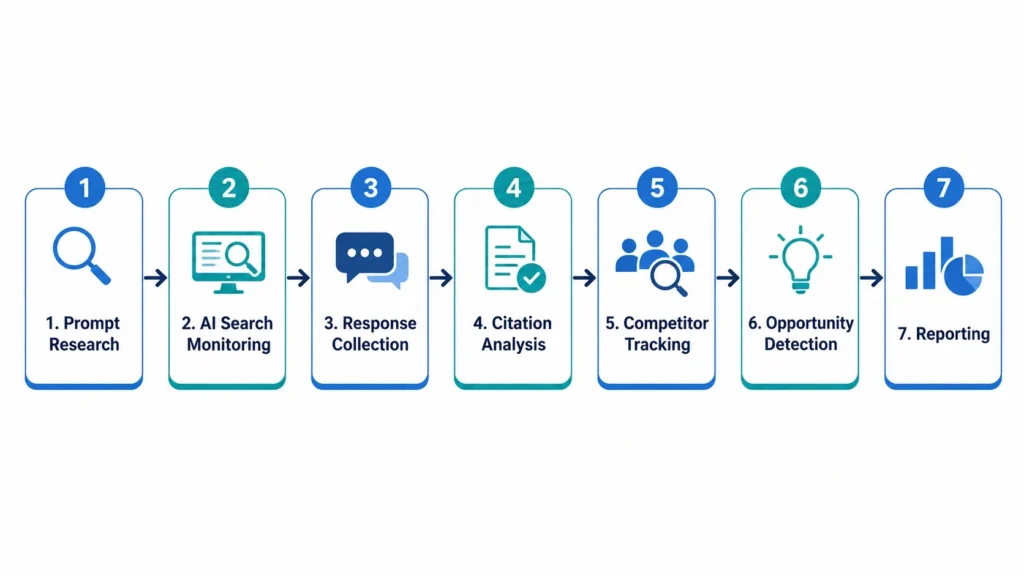
A simple workflow can connect:
Prompt Research → AI Search Monitoring → Response Collection → Citation Analysis → Competitor Tracking → Opportunity Detectio
AI can then help categorize opportunities and identify patterns.
For example, a system could identify that a competitor appears repeatedly for commercial prompts while your brand is missing.
The marketer can then investigate whether the issue is related to content, technical SEO, authority, brand visibility, or external citations.
This makes AI automation a useful extension of SEO and GEO work.
The goal is not to remove the marketer.
The goal is to reduce repetitive work so the marketer can focus on strategy.
Final Thoughts
AI search is becoming an important part of digital marketing.
Businesses are no longer competing only for positions in traditional search results. They also need to understand how their brands appear when customers use AI-powered search experiences.
The best AI search optimization platform will depend on the size of the business and the type of visibility you need.
Semrush is a strong overall choice for businesses that want to combine SEO and AI visibility.
Ahrefs Brand Radar is useful for competitive AI visibility research, citations, and search-backed prompt analysis.
Profound is designed more for enterprise AI search intelligence and includes documented enterprise security capabilities.
OtterlyAI is a focused option for businesses and agencies that primarily want AI search monitoring.
BrightEdge is a strong enterprise option for organizations that want AI search integrated into a broader SEO environment.
The important thing is not simply choosing a platform.
Businesses need to understand what the data means and use it to improve their SEO, content, brand authority, and overall digital presence.
AI search optimization is still evolving.
The platforms will change.
The AI models will change.
The way people search will continue to change.
For marketers, the real advantage will come from learning how to measure AI visibility, understand why a brand appears in AI answers, and turn those insights into a practical SEO and marketing strategy.
Want to improve your brand’s visibility in AI search? Hotbit Digital provides SEO and AI search optimization services designed to help businesses strengthen their presence across Google and AI-powered search platforms. From technical SEO and content optimization to authority building, competitor research, and AI visibility monitoring, our team can help turn search insights into a practical growth strategy.
Frequently Asked Questions
What are AI search optimization platforms?
AI search optimization platforms help businesses monitor and improve their visibility across AI-powered search experiences. These tools can track brand mentions, citations, competitors, prompts, and other visibility signals.
What are the best AI platforms for Answer Engine Optimization?
Semrush, Ahrefs Brand Radar, OtterlyAI, Profound, and BrightEdge are among the platforms worth considering. The best option depends on business size, SEO requirements, AI platforms being targeted, and reporting needs.
What are the best AI search optimization platforms in 2026?
Semrush, Ahrefs Brand Radar, Profound, OtterlyAI, and BrightEdge are strong options to evaluate in 2026. Each platform has a different focus, from traditional SEO integration to dedicated AI search monitoring and enterprise search intelligence.
What are the best AI SEO tools for small businesses in 2026?
Semrush, Ahrefs, and OtterlyAI are practical options for many small businesses. The right platform depends on whether the business needs a full SEO platform or primarily wants AI visibility monitoring.
What are the best AI SEO tools for enterprise businesses?
Profound, BrightEdge, and Semrush Enterprise AIO are strong options for enterprise organizations. Businesses should compare security, scalability, integrations, reporting, user controls, and AI platform coverage before making a decision.
Which AIO platforms provide the best enterprise security and privacy?
Profound and BrightEdge have strong publicly documented enterprise security credentials. Profound documents SOC 2 Type II compliance, SSO, and role-based access controls, while BrightEdge documents SOC 2 and ISO 27701 and provides enterprise security information.
Is GEO replacing SEO?
No. GEO is not a replacement for traditional SEO. Technical SEO, high-quality content, authority, website structure, and other SEO fundamentals continue to matter for modern AI search experiences.
Can AI search optimization be automated?
Yes. Prompt monitoring, data collection, competitor tracking, citation analysis, reporting, and parts of the research process can be automated. Human input is still important for strategy and deciding which opportunities should be acted on.