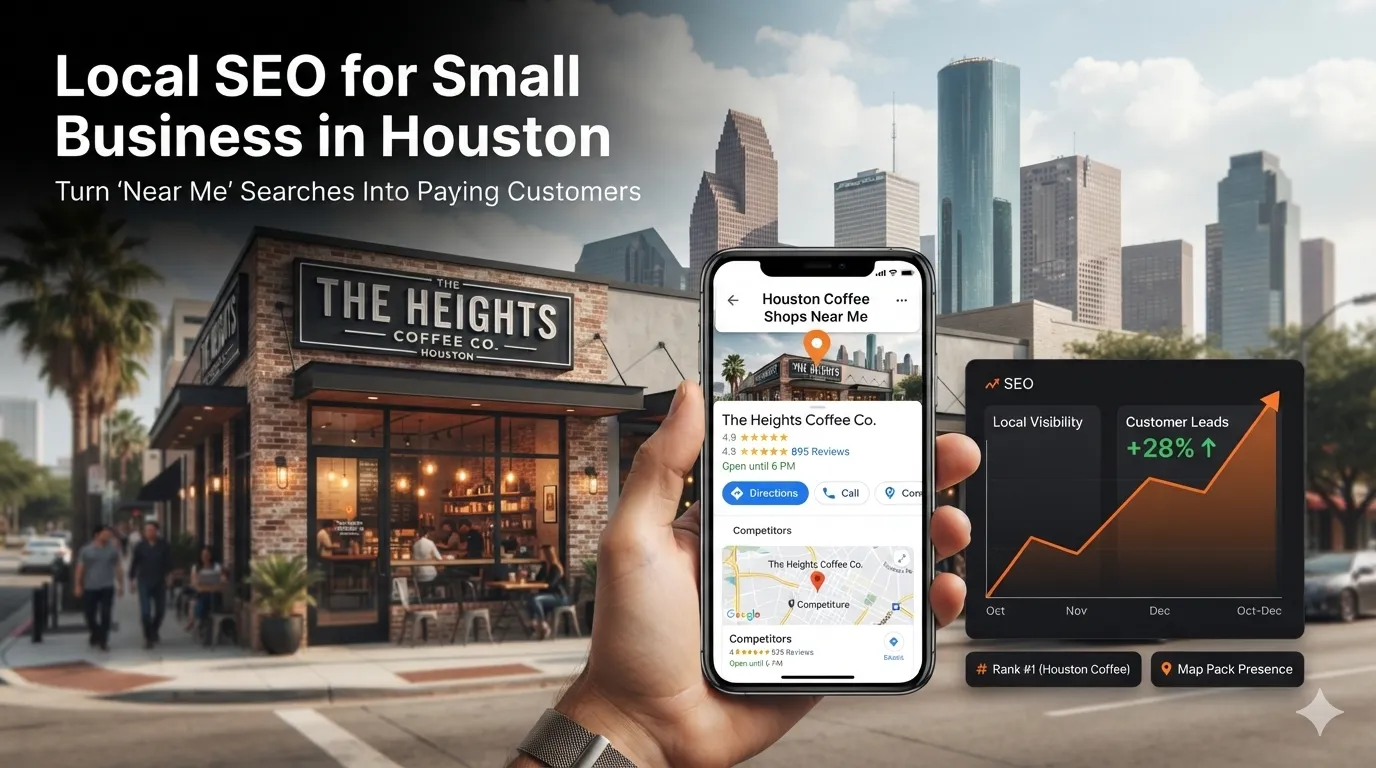
Local SEO for Small Business in Houston: Turn “Near Me” Searches Into Paying Customers

Local SEO for Small Business in Houston
A customer in Houston searches Google for “roof repair near me.”
Another searches for “best dentist in Houston.”
Someone else types “HVAC company near me” because their air conditioner stopped working in the middle of the day.
These aren’t casual searches. In many cases, the person behind the search is already looking for someone to hire.
For a small business, appearing at that moment can mean a phone call, appointment, quote request, store visit, or sale.
That is the real opportunity behind local SEO for small business in Houston.
Local SEO isn’t simply about putting your city name on a website or collecting a few Google reviews. It’s about making your business easier for search engines to understand and easier for local customers to find, trust, and contact.
And in a market as large and competitive as Houston, that distinction matters.
This guide explains how local search works, why your business may not be showing when customers search nearby, what you can do to improve your visibility, and how to turn that visibility into actual customers.

What Is Local SEO for a Small Business in Houston?

Local SEO is the process of improving your business’s visibility when people search for products or services in a particular geographic area.
For a Houston business, that might mean appearing when someone searches:
  • plumber Houston TX
  • AC repair near me
  • family dentist Houston
  • roofing company near me
  • personal injury lawyer Houston
  • restaurant near me
  • accountant in Houston
Some searches include the location explicitly. Others don’t.
When someone searches “plumber near me,” Google can use available location information to determine which businesses are relevant to that search.
Google says local results are primarily based on relevance, distance, and prominence. Relevance is how well a business matches the search, distance considers how far it is from the searcher or specified location, and prominence reflects how well-known the business is.
That means local SEO isn’t about trying to trick Google into believing your business is in Houston.
It’s about building a credible online presence that accurately communicates:

What your business does.

Where you serve customers.

Why your business is relevant.

Why customers can trust you.

How Do I Get My Business to Show Up on Google Maps in Houston?

This is one of the first questions many local business owners ask when they realize competitors are appearing in Google Maps while they aren’t.

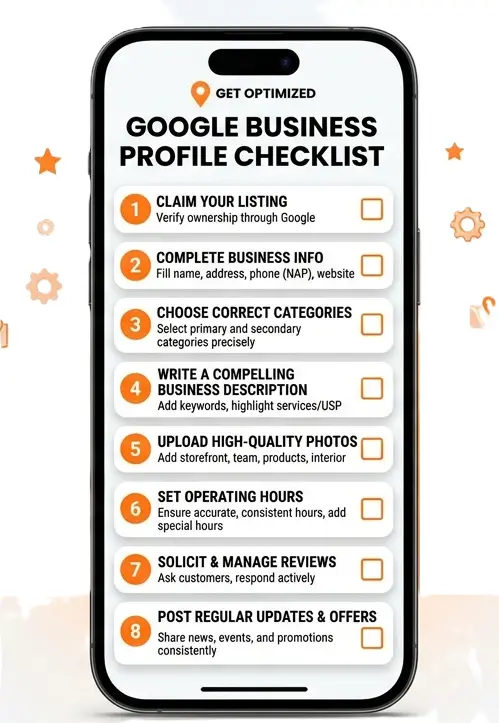
The starting point is your Google Business Profile.

If you haven’t claimed and verified your profile, do that first.
Then make sure the information accurately represents your real business:
  • Business name
  • Primary category
  • Additional relevant categories
  • Address or service area
  • Phone number
  • Website
  • Business hours
  • Services
  • Business description
  • Photos
  • Reviews
  • Relevant attributes
Google specifically recommends keeping Business Profile information complete and accurate because this helps Google understand what your business does, where it is, and when customers can visit.
But there is an important point that business owners often miss:
Completing your profile doesn’t guarantee a top position.
Google doesn’t provide a way to pay for or request a better local ranking. Local visibility depends on the search itself and Google’s assessment of relevance, distance, and prominence.
So if you’re asking, “How do I rank higher on Google Maps in Houston?”, the answer isn’t one magic setting.
You need to look at the entire local search presence.

Why Isn't My Business Showing on Google Maps?

If your business doesn’t appear when you search for your own services, don’t immediately assume that your Google Business Profile is broken.
There are several possible explanations.

1. The search may not be relevant enough

Google needs to understand that your business provides what the customer is looking for. If you’re a roofing contractor but your website and Business Profile provide little detail about your roofing services, Google has less information to work with.

2. The searcher may be outside your strongest geographic area

Distance is one of Google’s stated local ranking factors.
A business can appear prominently for a search performed close to its location and much lower—or not at all—for the same search performed across Houston.

3. Competitors may have stronger prominence

Other businesses may have a stronger overall presence across websites, reviews, links, local references, and organic search.

4. Your website may not support your local presence

Your Google Business Profile and website shouldn’t exist as completely separate entities
Your website should clearly explain your services, location, expertise, and service areas.

5. Your business information may be incomplete or inconsistent

Google gathers local business information from multiple sources, including business websites, business owners, users, and third-party data.
If important information is outdated or inconsistent, it can create unnecessary confusion.
The important lesson is this:

Don’t optimize only the Google Business Profile. Optimize the local presence around the business.

How Do I Get Into Google's Local 3-Pack?

The local 3-pack is the prominent local result that can appear above or alongside traditional organic listings for searches with local intent.
For example:

“HVAC repair Houston”

may show a map and a small set of local businesses. Naturally, many business owners want to know:

“How do I get into the Google 3-pack?”

There isn’t a guaranteed formula or a button you can press to get there.
Instead, think about the three areas Google explicitly identifies for local results:

Relevance

Does your business genuinely match the customer’s search?
Your categories, services, website content, and business information should make that clear.

Distance

How close is your business to the searcher’s location or the location included in the search?
You cannot simply optimize your way around geographic distance.

Prominence

How established and well-known is your business?
Google says prominence can be influenced by information such as links and reviews. This is why local SEO is broader than keyword placement.

How Can I Show Up for “Near Me” Searches?

You don’t need to create a page titled “Best Plumber Near Me.”

And you shouldn’t repeat “near me” throughout your website. Instead, build genuine relevance around the services and locations you actually serve.
Consider a Houston HVAC company.
A strong website might have pages for:
  • AC repair
  • AC installation
  • AC maintenance
  • Emergency HVAC service
  • Commercial HVAC
  • Heat pump services
The website can then explain the company’s actual Houston service area and provide useful local information.
Now Google has a much clearer relationship between:

Business → HVAC → Services → Houston → Customers

That’s more meaningful than simply repeating:
AC repair near me
AC repair near me
AC repair near me
throughout a page.

How Do I Optimize My Google Business Profile for Local Customers?

Start with accuracy. Your profile should represent the business customers actually encounter offline.

Choose the right primary category

Choose the right primary category

Describe your services accurately

If you provide emergency plumbing, drain cleaning, water heater repair, and leak detection, make those services clear.

Keep hours current

If you’re open late, closed on Sundays, or have holiday hours, make sure customers can see accurate information.

Add real photographs

Photos can help potential customers understand your business before contacting you. Depending on your industry, this could include:
  • Your location
  • Team members
  • Completed projects
  • Products
  • Equipment
  • Interior and exterior
  • Work in progress

Respond to customer reviews

Google recommends responding to reviews, noting that helpful replies show customers that their feedback matters.
The objective isn’t to make your profile look artificially active.
It’s to keep your business information useful and current.

How Do Google Reviews Affect Local SEO?

A good review strategy is simple:

Imagine you’re looking for a contractor.

Two companies appear in the search results.

One has a small number of reviews and little recent customer feedback.

The other has a substantial collection of genuine reviews describing customers’ experiences.

Which listing are you more likely to investigate?

Reviews matter because they serve two purposes.

They provide information to search engines.

And, perhaps more importantly, they provide evidence to potential customers.

Google identifies review count and positive ratings as factors that can contribute to local prominence.

But don’t turn review generation into a numbers game.

  1. Deliver a good customer experience.
  2. Ask genuine customers for honest feedback.
  3. Make leaving a review convenient.
  4. Respond professionally.
  5. Learn from recurring complaints.
Never buy fake reviews or manufacture customer experiences.
A strong reputation should be earned.

How Can I Get More Calls From Google?

Getting your business to appear in local search is only the first step.
The customer still needs a reason to contact you.
Suppose someone searches:

“emergency plumber near me”

They find your Google Business Profile.
They look at the reviews.
They visit your website.
Now what?
If the phone number is difficult to find, the website is slow, or the customer can’t quickly understand what you offer, you’ve introduced unnecessary friction.
Make the next step obvious.
Depending on your business, that could be:

Call Now

Request a Quote

Book an Appointment

Schedule Service

Get Directions

Contact Us

Local SEO works best when search visibility and conversion experience are considered together.

What Should My Houston Business Website Say?

A local customer should be able to answer four questions quickly:

What do you do?

Explain your products or services clearly.

Where do you serve?

Be specific about your actual service area.

Why should I trust you?

Show legitimate evidence:
  • Experience
  • Qualifications
  • Reviews
  • Case studies
  • Completed projects
  • Industry memberships
  • Certifications where applicable
  • Customer testimonials

What should I do next?

Give visitors a clear path to contact you.
This is particularly important for businesses where the customer isn’t looking to read a 2,000-word article.
They may simply want to know:

“Can you solve my problem, and how do I contact you?”

Your website should answer both.

Houston SEO for Local Businesses: Build Pages Around Services, Not Just Keywords

One of the most common local SEO mistakes is expecting one homepage to rank for every service.
Imagine a Houston plumbing company offering:
  • Emergency plumbing
  • Drain cleaning
  • Water heater repair
  • Sewer line repair
  • Leak detection
Instead of creating one enormous page, build a logical structure around the services customers actually need.
For example:

Plumbing Services in Houston

→ Emergency Plumbing
→ Drain Cleaning
→ Water Heater Repair
→ Sewer Line Repair
→ Leak Detection
Each service page can answer the customer’s specific questions.
That creates opportunities for searches such as:
“emergency plumber Houston”
“water heater repair near me”
“drain cleaning Houston TX”
“leak detection company near me”
This is much more useful than forcing every possible keyword onto the homepage.

What Local Content Should a Houston Business Publish?

Local content should solve real customer problems.
Don’t publish an article just because a keyword tool shows search volume.
Ask:

“Would a potential customer actually find this useful?”

For example, a Houston roofing company could publish:

How Much Does Roof Repair Cost in Houston?

A useful article could explain:
  • What affects roof repair costs
  • Common types of roof damage
  • How Houston weather can affect roofs
  • When repair may make sense
  • When replacement should be considered
  • What questions to ask a roofing contractor
A Houston HVAC company could publish:

Why Is My AC Not Cooling My House?

The article could explain common causes, what homeowners can safely check, and when professional service may be appropriate.

These pages naturally create topical relevance without forcing location keywords into every sentence.

Should I Create a Page for Every Houston Neighborhood?

Not automatically.

Houston includes many distinct communities and surrounding areas, but creating dozens of pages simply because you found dozens of place names is not a local SEO strategy.

Create a location page when your business genuinely serves that area and you can provide useful information.
For example, a business may legitimately serve:
  • The Heights
  • Montrose
  • Midtown
  • Downtown Houston
  • River Oaks
  • Memorial
  • West University
  • Galleria
  • Energy Corridor
A useful neighborhood page could explain:
  • Services available in the area
  • Service limitations
  • Local customer needs
  • Relevant projects
  • Local testimonials
  • Travel or service information
  • How to contact the business
The page should answer:

“Why is this business relevant to customers in this area?”

If the only difference between 20 location pages is the neighborhood name, you probably don’t have 20 useful pages.
You have one page copied 20 times.

How Do I Rank My Business for “Best [Service] in Houston”?

Searches containing “best” are different from simple location searches.
When someone searches:

“best dentist in Houston”

they are asking Google to help them evaluate options.
Your business needs more than a location signal.
You need evidence.
That might include:
  • Genuine customer reviews
  • Strong reputation
  • Demonstrated experience
  • Clear services
  • Useful educational content
  • Case studies
  • Expert information
  • Recognition or credentials that are genuinely applicable
Don’t simply claim:
“We’re the best dentist in Houston.”
Explain why customers trust you.

Evidence is stronger than adjectives.

How Do I Build Local Authority in Houston?

Local authority doesn’t come from submitting your website to hundreds of directories.
It comes from being a legitimate business with a legitimate presence.
That can include:
  • Local organizations
  • Houston business associations
  • Industry associations
  • Community organizations
  • Local publications
  • Events
  • Sponsorships
  • Partnerships
  • Relevant local websites
For example, a Houston business that participates in a legitimate community event may earn a mention from the organization hosting it.
A local expert who contributes useful commentary to a relevant publication may earn coverage. These are real relationships. And real relationships are generally more valuable than artificial link-building schemes.

What Are Local Citations and Does My Business Need Them?

A citation is a reference to your business information on another website or platform.
This may include:
  • Business directories
  • Industry directories
  • Review websites
  • Local organizations
  • Professional associations
  • Chamber websites
The important thing isn’t to get your business listed everywhere.
It’s to make sure important information is accurate.
Google says it gathers information about local businesses from multiple sources, including publicly available web content, third-party data, user contributions, and business owners.
That means maintaining a consistent digital footprint is worthwhile.
If your business moved six months ago but several important websites still show the old address, fix them.

What About Local SEO for Service-Area Businesses?

Not every Houston business has a storefront customers visit.
Plumbers, electricians, roofers, HVAC companies, cleaners, landscapers, and other service businesses may travel to customers.
For these businesses, the local SEO strategy needs to reflect the actual service area.
Don’t create fake office locations.
Don’t claim addresses where you don’t operate.
Instead, clearly explain where you provide services and make sure your Business Profile and website accurately represent the business.
This is especially important because distance is part of Google’s local ranking system.

How Does Mobile Search Affect Local Customers?

Local searches often happen when someone needs something immediately.

They’re standing outside a restaurant.

Their AC stopped working.

They need a nearby dentist.

They need a contractor.

They’re already on their phone.

That means your website should make the next action obvious.

A mobile visitor shouldn’t have to:

Open the menu → find contact → scroll → search for phone number.

Instead, important actions should be easy to find:

Call

Get Directions

Request a Quote

Book

Contact

And the page itself needs to load efficiently.

Hotbit’s technical SEO and page-speed services specifically focus on site performance, mobile experience, crawling, and Core Web Vitals.

How Can I Tell Whether Local SEO Is Actually Working?

Ranking reports are useful, but they aren’t the whole story.
A business owner ultimately cares about customers.
Track the journey from visibility to lead.

Search visibility

  • Local search impressions
  • Organic clicks
  • Local keyword visibility
  • Map visibility

Google Business Profile

  • Profile views
  • Search queries
  • Website clicks
  • Calls
  • Other available interactions

Website

  • Organic traffic
  • Service-page visits
  • Contact-page visits
  • Engagement

Leads

  • Phone calls
  • Contact forms
  • Quote requests
  • Appointments
  • Bookings

Business results

  • Qualified leads
  • New customers
  • Revenue where attribution is available

The better question isn’t:

“Did I move from position 7 to position 4?”

It’s:

“Are more qualified Houston customers finding and contacting my business?”

That’s the metric that connects SEO to the business.

What Should a Small Business Do First If Local SEO Isn't Working?

Don’t start by publishing 50 blog posts.

Start with an audit.

Check your Google Business Profile.

Is it verified?

Is the primary category accurate?

Are the services complete?

Are your hours correct?

Is the business information current?

Check your website.

Can Google clearly understand what you do?

Does the website clearly communicate Houston and your actual service area?

Do your most important services have dedicated pages?

Check your reputation.

Are customers leaving genuine reviews?

Are you responding?

Are there recurring complaints you should address?

Check your local footprint.

Are important business details consistent across the web?

Are there legitimate local organizations or industry websites mentioning your business?

Check your conversions.

When someone finds you, can they easily call, request a quote, or book?

This process often reveals more useful opportunities than simply adding more keywords.

A Practical Local SEO Strategy for a Houston Small Business

A sustainable strategy can be broken into five areas.

1. Establish the foundation

Get the Business Profile, website, business information, categories, services, and tracking in order.

2. Build topical relevance

Create strong service pages and useful content around the problems your customers actually search for.

3. Build local trust

Earn genuine reviews, local mentions, relationships, and relevant links.

4. Improve conversion

Make it easy for someone who discovers you through Google to contact your business.

5. Measure and improve

Use actual search and lead data to identify what is working and what needs attention.
This approach is more sustainable than chasing a single keyword.

The Questions Houston Business Owners Are Really Asking

When business owners talk about local SEO, the question usually isn’t:
“How do I optimize my semantic entities?”
It’s:

“Why isn’t my business showing on Google?”

“How do I get my business on Google Maps?”

“How do I rank higher on Google Maps?”

“Why am I not showing in the local 3-pack?”

“How do I show up when people search near me?”

“How do I get more calls from Google?”

“Why does my competitor appear above me?”

“How can I get more customers from Google?”

These questions all point to the same underlying issue:
Your business needs to be visible at the moment a local customer is ready to take action.
That’s what local SEO should ultimately accomplish.

Local SEO for Small Business in Houston: From Visibility to Revenue

A Google ranking is not the end goal.
A map listing isn’t the end goal.
Website traffic isn’t the end goal.
The business outcome is the important part.

More qualified local visibility → more relevant visitors → more calls and inquiries → more customers.

For a Houston business, that means building a connected presence across:
  • Google Business Profile
  • Google Maps
  • Organic search
  • Service pages
  • Local content
  • Customer reviews
  • Business directories
  • Local websites
  • Mobile experience
  • Conversion paths
And it needs to be maintained.
Competitors change.
Customer behavior changes.
Search results change.
Your services change.
Your business grows.
Local SEO should grow with it.

How Hotbit Digital Can Help

For businesses that want to improve their local search visibility, the first step shouldn’t be a generic package of keywords.
It should be understanding where the business currently stands, what customers are searching for, what competitors are doing, and where the biggest gaps exist.
Hotbit Digital provides SEO and digital marketing services that include local SEO, technical SEO, content, audits, and conversion-focused optimization.
A local SEO campaign can then be built around the business’s actual services, locations, customers, competition, and growth objectives.
If your business is getting referrals but struggling to generate consistent customers from Google, start by finding out what is preventing you from being discovered locally.

Explore Hotbit Digital’s Local SEO Services and learn how a structured local search strategy can support your business’s growth.

Frequently Asked Questions

1. How do I get my business on Google Maps in Houston?

Claim and verify your Google Business Profile, then provide complete and accurate information about your business, including the appropriate category, address or service area, hours, services, phone number, and website. Google uses Business Profile information along with information from other sources to generate local listings.

2. How do I rank higher on Google Maps?

There is no guaranteed shortcut. Google says local results are primarily influenced by relevance, distance, and prominence. Improving the accuracy and completeness of your Business Profile, strengthening your website and local relevance, earning genuine reviews, and developing legitimate authority can all form part of a broader local SEO strategy.

3. Why isn't my business showing up on Google Maps?

Your visibility can vary based on the search query, searcher’s location, relevance, competition, and prominence. Check your Business Profile information, categories, services, website, reviews, and broader local presence before assuming there is a technical problem.

4. How do I get into Google's 3-Pack?

You cannot request or pay Google to place your business in the local 3-pack. Focus on the factors Google identifies for local ranking: relevance, distance, and prominence.

5. How do I show up for “near me” searches?

Build genuine relevance around your services and actual service area. Maintain accurate Business Profile information, create useful service pages, develop relevant local content, earn genuine reviews, and make your business information consistent across the web.

6. Do I need a separate “near me” page?

No. A page created solely to repeat “near me” is unlikely to provide much value. Your website should instead demonstrate what you offer, where you serve customers, and why your business is relevant to the search.

7. How can I get more calls from Google?

Improve your visibility for relevant local searches and make it easy for customers to contact you once they find you. Keep your Business Profile accurate, build trust through genuine reviews, create useful service pages, and make phone and contact options prominent.

8. Does my website affect local SEO?

Your website is an important part of your broader online presence. It gives search engines and customers more information about your services, location, expertise, and business. Google also says information from a business’s website can contribute to local listings.

9. Should I create pages for every Houston neighborhood?

Only when your business genuinely serves those areas and you can provide useful, unique information. Creating many nearly identical pages simply by changing neighborhood names can create low-value content.
10. Are reviews important for local SEO?

Only when your business genuinely serves those areas and you can provide useful, unique information. Creating many nearly identical pages simply by changing neighborhood names can create low-value content.

11. How long does local SEO take to work?

There is no universal timeline. Results depend on competition, location, website strength, existing visibility, Business Profile condition, reviews, content, authority, and other factors. Local SEO should be treated as an ongoing process rather than a one-time optimization.

Final takeaway

If a Houston customer is searching for your service today, can they find you?
If they find you, do they trust you?
And if they trust you, can they easily contact you?
Those three questions are at the heart of effective local SEO.
The objective isn’t simply to rank for “Houston.”
It’s to build a local presence strong enough that the right customer can discover your business, understand what you offer, trust your expertise, and take the next step.

Categories

Related Posts

No tags found.