B2B search is changing.
For years, companies have optimized their websites primarily for traditional search engines: identify valuable keywords, create relevant content, improve technical SEO, build authority, and compete for prominent positions in search results.
That foundation still matters. But B2B buyers now have another way to research products, services, vendors, and solutions: AI-powered search and conversational answer engines.
Instead of searching for a series of short keywords, a buyer can ask a detailed question such as:
“What should a B2B SaaS company look for when choosing an AI search optimization service?”
The answer may combine information from multiple web sources, summarize competing viewpoints, and provide links to sources. ChatGPT Search, for example, can search the web and include citations to relevant sources in its responses.
This creates a new consideration for B2B marketers:
It’s no longer enough to be visible only when someone searches for your exact target keyword. Your brand and expertise also need to be discoverable when buyers ask broader, conversational questions about the problems you solve.
That’s where AI search optimization comes in.
AI search optimization focuses on making a company’s content and online presence easier for AI-powered search systems to discover, understand, evaluate, and potentially reference when generating answers.
For B2B organizations, this means combining the fundamentals of SEO with strong topical authority, useful content, clear entity information, credible sources, technical accessibility, and a deep understanding of how prospects research solutions.
In this guide, we’ll cover what AI search optimization means for B2B marketing, how it differs from traditional SEO, which strategies companies can implement, what an AI search optimization service may include, and how to measure progress.
What Is AI Search Optimization for B2B Marketing?
AI search optimization is the practice of improving a company’s digital presence so that AI-powered search and answer systems can more effectively discover, understand, evaluate, and potentially reference its information.
For B2B marketing, this extends beyond optimizing individual pages for keywords.
A B2B company needs to communicate several layers of information clearly:
- What the company does
- Which problems it solves
- Which industries it serves
- Who its products or services are for
- What makes its approach different
- What evidence supports its claims
- Which topics it has genuine expertise in
- How its products or services compare with alternatives
This is where AI search optimization overlaps with several established disciplines, including search engine optimization (SEO), content marketing, semantic search, entity optimization, Answer Engine Optimization (AEO), and Generative Engine Optimization (GEO).
These terms are related, but they aren’t necessarily identical.
Traditional SEO focuses heavily on helping search engines discover, understand, and rank web pages. AI search optimization takes a broader view of how information can be discovered and represented in AI-generated answers.
AI search optimization vs. traditional SEO
Traditional SEO | AI Search Optimization |
Keyword targeting | Topics, entities, and concepts |
Search rankings | Visibility within AI-generated answers |
Search queries | Conversational and multi-part questions |
Individual pages | Connected information across a website |
Organic clicks | Mentions, citations, referrals, and conversions |
Backlinks and authority | Authority, credibility, references, and brand mentions |
SERP optimization | Answer and information optimization |
This does not mean that B2B companies should abandon traditional SEO.
In fact, a strong SEO foundation remains important. Google’s own documentation emphasizes that structured data can help its systems understand page content, while technical accessibility, indexing, and Search Essentials remain fundamental to search visibility.
The practical approach is to build on SEO rather than replace it.
Why AI Search Optimization Matters for B2B Companies
B2B buying journeys are often more complicated than straightforward consumer purchases.
A potential buyer may research:
- A business problem
- Possible solutions
- Different approaches information, authoritative sources, original
- Vendors
- Product features
- Pricing
- Alternatives
- Reviews and reputation
- Implementation requirements
- Industry-specific use cases
AI-powered search can participate in many of these research stages.
For example, a buyer might move from:
“What is generative engine optimization?”
to:
“How does GEO differ from SEO?”
then:
“How can a B2B SaaS company improve visibility in AI search?”
and eventually:
“What should I look for when hiring an AI search optimization agency?”
These questions have different search intents, but they belong to the same broader topic.
A strong B2B AI search strategy therefore needs to cover the topic ecosystem, not simply one keyword.
How AI Search Changes B2B Buyer Discovery
Traditional search often starts with a query and produces a list of pages.
AI search can instead interpret a more complex question and produce a synthesized response supported by web sources.
OpenAI describes ChatGPT Search as combining conversational interaction with web search and links to sources, allowing users to investigate topics through follow-up questions.
For B2B marketers, this changes the optimization opportunity.
Your potential customer might never type:
“AI search optimization service B2B”
into a search engine.
Instead, they might ask:
“Which strategies can help an enterprise software company increase its visibility in AI-generated search results?”
If your website comprehensively explains that problem, demonstrates relevant expertise, and provides useful supporting evidence, your content has a better opportunity to become part of the information ecosystem surrounding that question.
The goal is therefore not simply to rank for a keyword. It is to become a useful and credible source for the questions your target buyers ask.
7 AI Search Optimization Strategies for B2B Marketing
1. Build Topical Authority Around Your Core Expertise
One article rarely establishes expertise around a complex subject.
Instead, create a connected content ecosystem.
For B2B AI search optimization, that could include:
- AI search optimization
- Generative Engine Optimization
- Answer Engine Optimization
- AI visibility
- B2B SEO
- AI content optimization
- LLM-based search
- Conversational search
- AI search measurement
- B2B content strategy
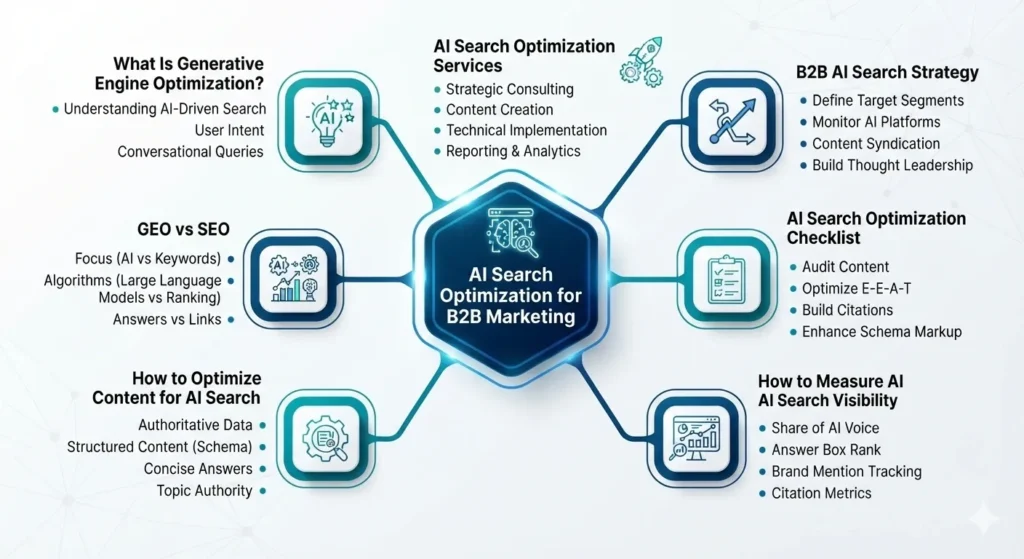
Create a comprehensive pillar page and support it with specialized resources
For example:
AI Search Optimization for B2B Marketing
├── What Is Generative Engine Optimization?
├── GEO vs SEO
├── How to Optimize Content for AI Search
├── How to Measure AI Search Visibility
├── AI Search Optimization Checklist
├── B2B AI Search Strategy
└── AI Search Optimization Services
2. Optimize for Questions, Not Just Keywords
B2B buyers rarely have a single question.
Their research expands.
A keyword such as:
AI search optimization service B2B
can produce dozens of related questions:
- What does an AI search optimization service include?
- How does AI search optimization work?
- How is AI search optimization different from SEO?
- How can B2B companies improve AI visibility?
- How do you measure AI search optimization?
- How much does an AI search optimization service cost?
- Should a B2B company hire an agency?
- What content works best for AI search?
These questions should influence your content architecture.
Rather than forcing every variation into the article, answer the underlying information needs naturally.
3. Create Content That Can Stand on Its Own
AI systems need information they can interpret in context.
That makes clarity particularly important.
Instead of:
“It is an innovative approach that leverages modern technology to transform visibility…”
write:
AI search optimization helps businesses improve how their information can be discovered and understood by AI-powered search systems.
Then explain the concept.
Use:
- Clear definitions
- Descriptive headings
- Short paragraphs
- Lists
- Tables
- Examples
- Original data
- Supporting references
- Specific explanations
This also improves usability for human readers.
4. Strengthen Your Brand Entity
Your website should clearly communicate who your organization is and what it does.
Currently, your business presents itself as a specialized B2B solutions provider with offerings spanning enterprise software, cloud architecture, system integration, cybersecurity, and related technology consultancy. The site also identifies key industry expertise across sectors like finance, manufacturing, healthcare, and logistics.
For AI-search visibility, that information should remain consistent across your:
- Homepage
- About page
- Service pages
- Author pages
- Case studies
- Company profiles
- Relevant third-party mentions
The relationship should be clear:
[Your Company Name] → enterprise technology provider → cloud architecture → B2B solutions → AI-driven optimization
As your AI-search offering develops, the relevant service pages can strengthen that association further.
Tip: Keeping your brand messaging unified helps AI engines like ChatGPT, Perplexity, and Google’s Gemini accurately parse your entity graph and recommend your business for high-intent B2B queries.
5. Publish Original Research
This is one of the strongest ways to differentiate your content from generic AI-generated material.
For example, Hotbit could publish:
“State of AI Search Visibility for B2B Brands: 2026”
Research a defined set of B2B queries and document:
- Which brands appear
- Which domains are cited
- Which content formats appear
- How frequently brands are mentioned
- Which sources appear repeatedly
- How results differ across AI search platforms
Publish the methodology alongside the findings.
This creates something other websites can reference.
That can generate:
Original research → external references → brand mentions → links → authority → broader discoverability
It also gives Hotbit something more valuable to say than another generic list of “AI SEO tips.”
6. Make Your B2B Service Pages More Informative
Your blog can explain what AI search optimization is.
A service page should explain:
how Hotbit Digital approaches it.
For example, an AI search optimization service page could explain:
Discovery
- Business objectives
- Target audience
- Products/services
- Competitors
- Existing search visibility
AI Search Research
- Buyer questions
- Conversational queries
- Topic gaps
- Competitor visibility
- Brand mentions
Content & Entity Optimization
- Existing content
- Topic clusters
- Entity consistency
- Service pages
- Supporting resources
Authority Development
- Original research
- Digital PR
- Expert contributions
- Relevant external mentions
Measurement
- AI visibility
- Brand mentions
- Citations
- Referral traffic
- Organic performance
- Qualified leads
This turns AI search optimization from an abstract concept into a recognizable B2B service.
7. Strengthen Technical SEO and Machine Accessibility
AI search optimization does not eliminate technical SEO.
If important information cannot be reliably accessed, crawled, or understood, content optimization has limited value.
Review:
- Robots.txt
- Noindex directives
- Canonical URLs
- XML sitemap
- Internal links
- Page rendering
- Mobile usability
- Site speed
- HTTPS
- Crawl errors
- Status codes
- JavaScript-dependent content
Google recommends checking that pages are accessible to its crawlers and aren’t blocked by robots.txt, noindex, or login requirements when implementing and validating structured data.
OpenAI also notes that ChatGPT may not be able to obtain information from websites because of technical issues, paywalls, or robots.txt preferences.
So before worrying about advanced AI-search tactics, make sure the fundamentals work.
AI Search Optimization Services for B2B Companies
An AI search optimization service should not simply mean “we add AI keywords to your website.”
A more complete B2B approach can include several connected activities.
AI Search Visibility Audit
Identify:
- Existing brand visibility
- Relevant buyer queries
- Competitor visibility
- Content gaps
- Citation opportunities
- Technical barriers
LLM Fan-Out Research
Start with commercial topics and expand them into the questions buyers may ask AI systems.
For example:
AI search optimization service
can expand into:
- What does AI search optimization do?
- Which businesses need it?
- How does it differ from SEO?
- How much does it cost?
- What should an agency provide?
- How do you measure results?
Content Optimization
Improve:
- Existing pages
- Service pages
- Blog content
- Comparison content
- Guides
- Case studies
- Research assets
Entity Optimization
Establish clear relationships between:
Brand → service → expertise → people → industries → evidence
Authority Development
Build legitimate recognition through:
- Original research
- Industry publications
- Expert contributions
- Digital PR
- Relevant partnerships
- Authoritative references
Monitoring
Track changes in:
- AI mentions
- Citations
- Query coverage
- Competitor visibility
- Referral traffic
- Organic search performance
AI Search Optimization vs. GEO vs. AEO vs. SEO
The terminology around AI search can be confusing.
SEO
Search Engine Optimization focuses on improving a website’s visibility in search engines.
AEO
Answer Engine Optimization generally focuses on making information useful and accessible for systems that provide direct answers to questions.
GEO
They visit your wGenerative Engine Optimization generally refers to optimizing information and online presence for generative AI systems and their generated responses.ebsite.
AI Search Optimization
This can be used as a broader term encompassing optimization for AI-mediated search and discovery.
The terminology isn’t completely standardized across the industry, so businesses should pay more attention to the actual methodology and outcomes than to the label an agency uses.
How to Make B2B Content More Citation-Worthy
One of the most useful questions to ask when creating content is:
“Why would another system or person use this page as a source?”
The answer shouldn’t simply be:
“Because we used the right keywords.”
Give readers something worth referencing.
Include original insights
Explain what your team has learned from actual work.
Use credible sources
When presenting statistics or industry claims, identify the original source.
Show methodology
If you conduct research, explain how the data was collected.
Provide specific examples
Generic advice is easy to reproduce.
Specific examples are more useful.
Update information
AI search systems can retrieve current web information, and users should be able to verify important claims against their sources.
How to Measure AI Search Optimization
AI visibility should not become a vanity metric.
Track it alongside traditional marketing metrics.
Area | Metrics |
AI visibility | Brand mentions, citation frequency, query coverage |
Search | Organic impressions, clicks, rankings |
Website | Engagement, referral traffic, conversions |
Lead generation | MQLs, SQLs, qualified leads |
Revenue | Pipeline and revenue contribution |
Authority | Relevant mentions, references, links |
The objective is not simply:
“Our brand appeared in an AI answer.”
The bigger question is:
“Is AI-driven discovery helping relevant prospects discover and evaluate our business?”
Common AI Search Optimization Mistakes
Keyword stuffing
Repeating “AI search optimization” dozens of times won’t establish genuine topical authority.
Publishing generic AI-generated content at scale
More pages do not automatically mean more authority.
Creating dozens of near-identical landing pages
Changing one keyword while keeping the same content creates little additional value.
Ignoring traditional SEO
AI search and conventional search aren’t separate universes.
Technical accessibility, useful content, internal linking, and authority still matter.
Making unsupported claims
Don’t claim that a particular tactic guarantees ChatGPT citations or AI rankings.
Optimizing only one platform
B2B buyers use different search and AI products. Build a durable information ecosystem rather than chasing a single platform.
A Practical B2B AI Search Optimization Framework
A sustainable strategy can be organized into eight steps.
Step 1: Define your entities
Identify your:
- Brand
- Products
- Services
- Industries
- Experts
- Customers
- Topics
Step 2: Map buyer questions
Build queries across:
Awareness → Research → Comparison → Evaluation → Purchase
Step 3: Audit existing content
Find:
- Missing topics
- Weak pages
- Duplicate content
- Outdated information
- Poor internal linking
- Unsupported claims
Step 4: Build topical clusters
Connect pillar pages with supporting resources.
Step 5: Improve commercial pages
Make your service and product information comprehensive and easy to understand.
Step 6: Build external authority
Develop original research, expert contributions, PR, partnerships, and relevant third-party references.
Step 7: Fix technical barriers
Make sure search systems can access and understand your content.
Step 8: Measure and iterate
Monitor both AI visibility and actual business performance.
What About Structured Data and llms.txt?
Structured data can help search engines understand and classify page information. Google specifically documents supported structured-data types such as Article, Breadcrumb, Organization, and others.
For this article, relevant markup should be considered based on the actual page content—for example, Article/BlogPosting and BreadcrumbList, alongside appropriate site-level Organization information.
But structured data shouldn’t be treated as a guaranteed AI-search ranking mechanism.
“Why would another system or person use this page as a source?”
Specific examples are more useful.
Update information
AI search systems can retrieve current web information, and users should be able to verify important claims against their sources.
How to Measure AI Search Optimization
The same applies to llms.txt.
A well-maintained llms.txt can potentially serve as a machine-readable map of important website resources, but I would not promise that adding it will make Hotbit rank in ChatGPT. AI search systems have different retrieval and ranking mechanisms, and ChatGPT Search can use web search and source selection dynamically.
For Hotbit, I’d use it as an additional website-level knowledge/discovery layer, not as a substitute for SEO, content, authority, or technical accessibility.
Final Thoughts
AI search doesn’t mean the end of SEO.
It means B2B search is becoming more conversational, contextual, and information-driven.
Companies that want to build visibility in this environment should look beyond individual keywords and think about the complete information ecosystem surrounding their brand.
That means creating authoritative content, answering real buyer questions, strengthening technical foundations, developing recognizable entities, publishing original research, earning relevant third-party recognition, and measuring whether increased visibility translates into meaningful business outcomes.
For a digital marketing agency such as Hotbit Digital, this evolution fits naturally alongside the SEO, content marketing, paid media, social media, and website-development capabilities already offered across its digital marketing services.
The opportunity is not simply to optimize one page for an AI search engine.
It is to build a digital presence that search engines, AI systems, and—most importantly—B2B buyers can understand and trust.
FAQs About AI Search Optimization for B2B Marketing
What is AI search optimization?
AI search optimization is the practice of improving a company’s online content, technical accessibility, authority, and entity information so AI-powered search and answer systems can more effectively discover, understand, evaluate, and potentially reference that information.
Is AI search optimization the same as SEO?
No. AI search optimization overlaps with SEO but focuses more broadly on visibility within AI-mediated discovery and generated answers. Traditional SEO remains an important foundation.
What is AI search optimization for B2B companies?
It is the process of improving a B2B company’s website and broader online presence so its products, services, expertise, and information are easier for AI-powered search systems to discover and understand.
What is GEO in B2B marketing?
Generative Engine Optimization (GEO) generally refers to strategies intended to improve how a brand’s information appears or is represented in generative AI responses.
How can B2B companies improve AI search visibility?
Start with technical SEO, comprehensive topic coverage, clear entity information, authoritative sources, original research, strong service pages, relevant external mentions, and ongoing monitoring of AI-generated results.
Does traditional SEO still matter for AI search?
Yes. Search engines and AI systems still need to discover and retrieve information from the web. A technically accessible website with useful, authoritative content provides an important foundation.
Can an AI search optimization service guarantee ChatGPT rankings?
No responsible provider should guarantee a specific ChatGPT position or citation. AI-generated results can vary according to the query, available sources, search behavior, freshness, and the platform’s own systems.
How should B2B companies measure AI search optimization?
Measure AI brand mentions, citations, query coverage, referral traffic, organic search performance, qualified leads, and ultimately pipeline or revenue contribution.